War.gov Release 05
Editor's Picks
5Curated highlights from this Drop.
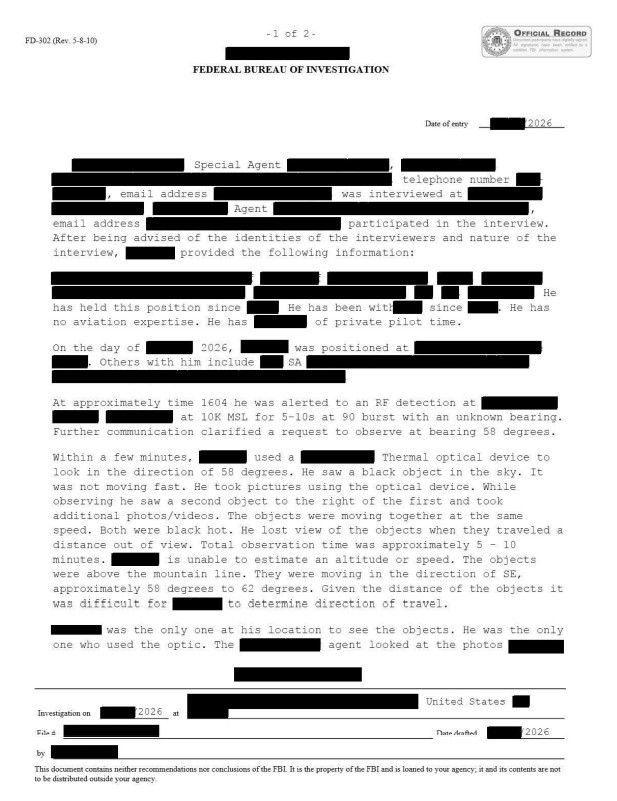
FBI-UAP-D032, FD-302, “Slow-moving Objects,” 2026
This document is an FBI FD-302, a form the Federal Bureau of Investigation (FBI) uses to record interviews. This FD-302 records a 2026 interview with a U.S. Government Special Agent, in which the interviewee describes an incident potentially involving unidentified anomalous phenomena (UAP) in the western United States, at approximately 4:00 PM local time, in 2026. This FD-302 is accompanied by video footage captured during the incident, under the title FBI-UAP-PR007.
Editor's note: An FBI interview record tied to thermal video footage of two slow-moving “black-hot” areas of contrast in the western United States.
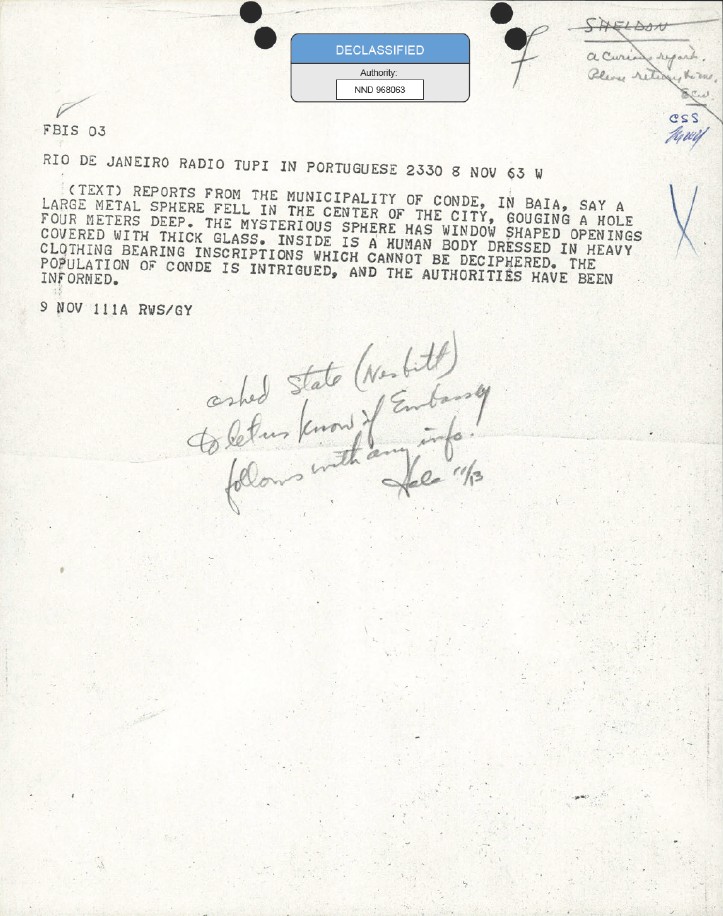
EOP-UAP-D001, NASC Inquiry into Bahia, Brazil Incident, November 13, 1963
This document is a Central Intelligence Agency (CIA) Foreign Broadcast Information Service (FBIS) wire report dated November 9, 1963, tracking a local Portuguese-language radio broadcast from Rio de Janeiro, Brazil, regarding an alleged crash of a “large metal sphere” containing a deceased occupant in Conde, Bahia, Brazil. This FBIS report is excerpted from the files of Edward C. Welsh, Executive Secretary of the National Aeronautics and Space Council (NASC). NASC was a cabinet-level advisory body within the Executive Office of the President responsible for coordinating U.S. space policy from 1958 to 1973. Handwritten annotations dated November 13, 1963, document a communication between officials at NASC and the U.S. Department of State. The note records a NASC request to a State Department official to query the U.S. Embassy in Rio de Janeiro for local verification of the reporting. This inter-agency request precedes a subsequent diplomatic cable sent by the Embassy the following day, cataloged in this collection under the title “DOS-UAP-D001.”
Editor's note: An Executive Office of the President/NASC record showing inter-agency follow-up on a reported Brazil incident involving a “large metal sphere.”
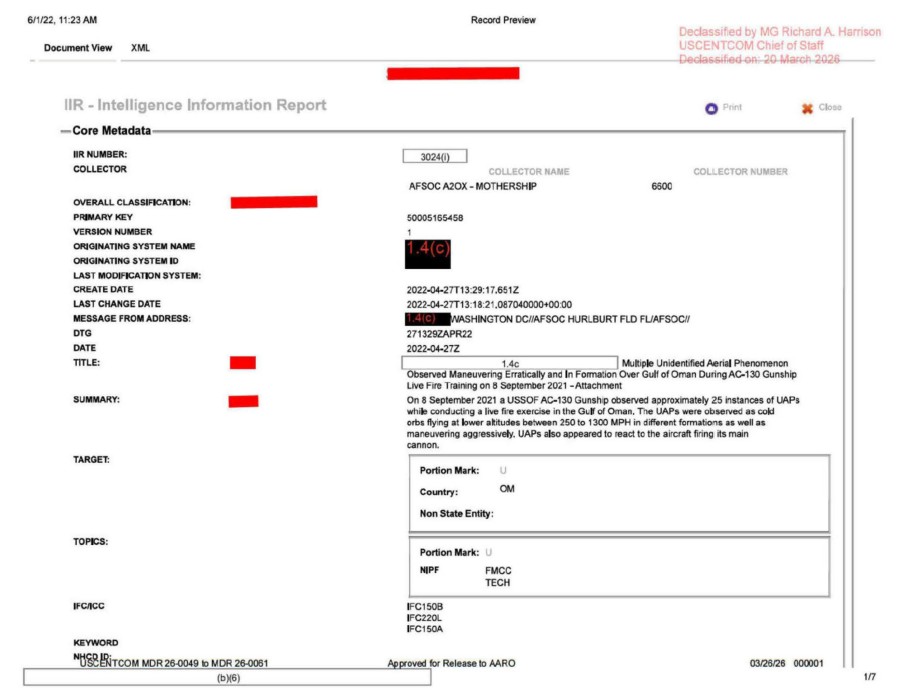
DOW-UAP-D101, Intelligence Information Report, Unresolved UAP Report, Gulf of Oman, 2021
This document is an Intelligence Information Report (IIR), the primary standardized format utilized by the Department of War, military services, and the broader Intelligence Community to disseminate unevaluated intelligence information derived from human sources (HUMINT), open sources, and field collection activities. IIRs are not finished intelligence products; they serve as inputs for subsequent all-source intelligence assessments. This report accompanies the footage contained within DOW-UAP-PR117 through DOW-UAP-PR122. This report documents an observation by the aircrew of a U.S. Special Operations Forces (USSOF) AC-130 Gunship on September 8, 2021, during a nighttime live-fire training exercise over the Gulf of Oman. The aircrew reported first observing two unidentified anomalous phenomena (UAP) after dropping a water-activated flare. The report describes the UAP as stationary, approximately four feet in diameter, 0-20 feet above the water’s surface. Throughout the training sortie, the aircrew reported observing approximately 25 instances involving similar phenomena via infrared sensor, describing them as “cold orbs.” Aircrew visual estimates of the UAP’s apparent speed range from 250 to 1,300 miles per hour. The report characterizes the UAP’s behavior as “maneuvering aggressively,” “flying in various formations,” and appearing to react to deployments of the aircraft’s onboard weapons systems. The aircrew stated that they were unable to capture video footage of the phenomena because the aircraft’s digital video recorder was not functioning during the incident. All descriptive and estimative language contained in this report reflects the reporter’s subjective interpretation at the time of the event. Such characterizations should not be interpreted as a conclusive indication of the presence or absence of any intrinsic object features or performance characteristics.
Editor's note: A modern Gulf of Oman case file linked to six related videos, with aircrew reporting multiple “cold orbs” observed by infrared sensor during a nighttime training exercise.
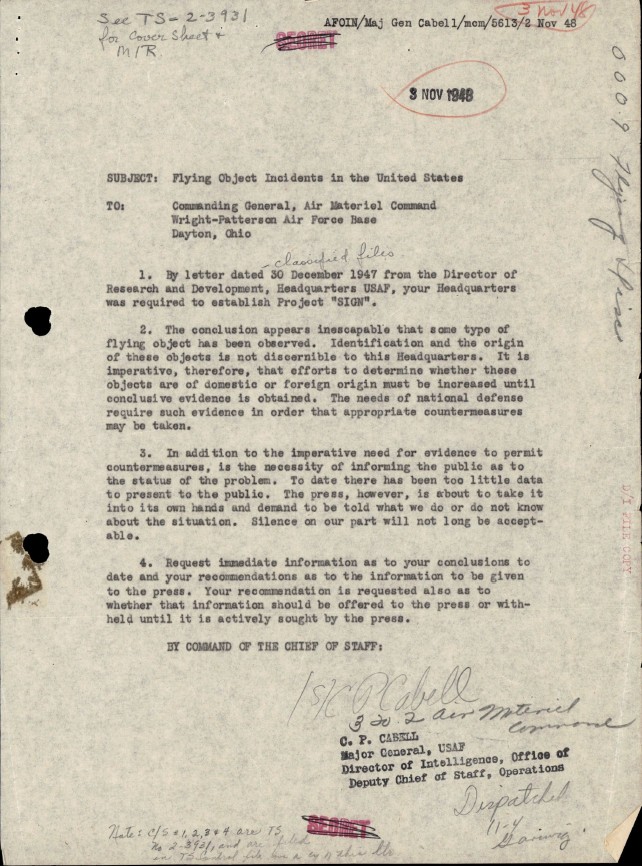
DOW-UAP-D100, Air Materiel Command Report on Unidentified Flying Objects, 1947-1948
This file is a collection of U.S. Government memoranda and correspondence relating to “Project Sign,” a 1948 U.S. Air Force program to investigate reports of high-performance airborne objects. The documents characterize some of these reports as being consistent with “real” objects rather than fabrications or resulting from perceptual errors. The U.S. Air Force cites the reported characteristics of the phenomena, e.g., high speed and maneuverability, as exceeding known performance envelopes of U.S. military aircraft and thereby presenting a potential national security threat, if validated. This potential threat prompted the Air Force to call on the Air Materiel Command (AMC), the Service’s Major Command for logistics and procurement from 1946 to 1961, to gather further evidence to assess the validity of the reports. The Air Force emphasized that there was an “imperative need” for such evidence to enable appropriate countermeasures. The stated urgency of this request reflects the strategic environment of the early Cold War, a period characterized by heightened national defense concerns amid rapid global advancements in aerospace design and development. In framing the call for an investigation, the Air Force noted that sustained public interest and persistent inquiries from the press may eventually require an official statement in response. AMC’s investigation found that observers were generally not mistaken when reporting that they had seen an airborne object, but that their characterizations of those objects as unusual was likely a reflection of the “limits of their personal experience.” It identified “a great many” of the objects reported with a rounded appearance as “weather or upper air scientific balloons of some type.” It also identified several cases in which the reported objects were most likely celestial phenomena, such as Venus. AMC found that a small number of reports lacked a “reasonable everyday explanation,” but that “so far, no physical evidence of the existence of the unidentified sightings has been obtained.” AMC expressly considered whether the phenomena may have been “vehicles from another planet,” but found no evidence supporting such an origin. Ultimately, AMC found that “there is as yet no conclusive proof that unidentified flying objects, other than those which are known to be balloons, are real aircraft.” In light of these findings, AMC recommended that the Department of War should avoid publicly commenting on the subject of “flying discs.” Responding to the Air Force’s anticipated concerns regarding public interest in the subject, AMC recommended that the Department should reply in terms that minimize the investigation’s inconclusive findings, focusing on positive determinations in cases assessed to be weather balloons and celestial phenomena.
Editor's note: A foundational early Cold War UFO file showing how the Air Force and Air Materiel Command weighed unusual reports, public pressure, possible threats, and inconclusive evidence.
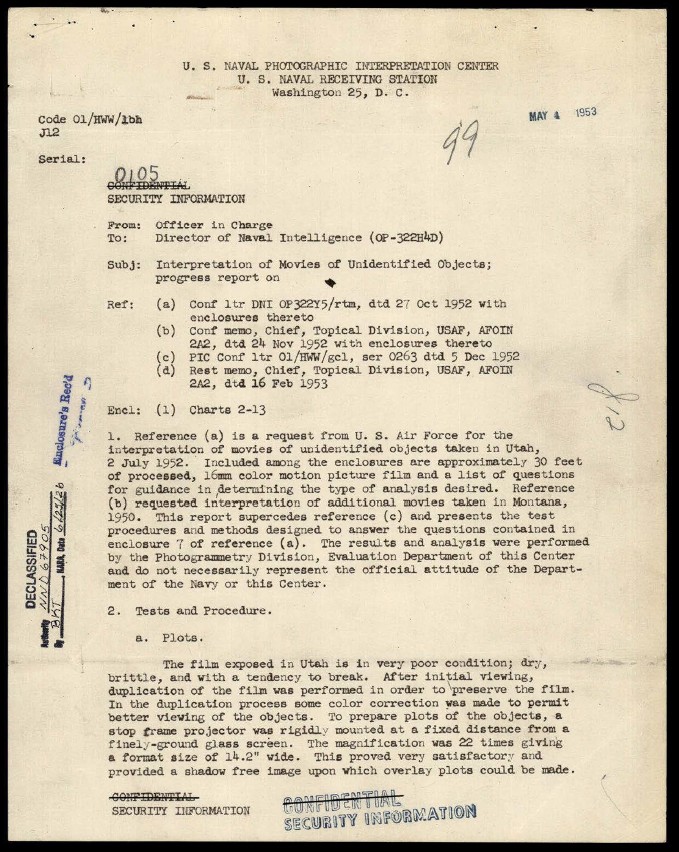
DOW-UAP-D098, Film Analysis of Unidentified Objects, 1953
This file contains a memorandum relating to the U.S. Naval Photographic Interpretation Center’s assessment of two films allegedly depicting unidentified airborne objects, captured in Montana and Utah in 1950 and 1952, respectively. The file documents the Center’s analytic process, assumptions that constrained its confidence level, tentative conclusions, and recommendations for future research. The Center assessed, generally, that the objects depicted in the film demonstrated characteristics that were inconsistent with those of natural phenomena or commonly known aerospace technologies. The memorandum documents the Center’s recommendation for a more well-resourced investigation to corroborate its presumptive findings, citing a lack of funding and personnel. The accompanying charts compare the film’s luminosity with the apparent angular size of the phenomena, using contemporary mathematical modeling and photogrammetric analysis techniques.
Editor's note: A 1953 naval photographic analysis of films from Montana and Utah that shows how early investigators evaluated unusual airborne objects using the tools and limits of the time.
All Files
Browse every official file in this Drop.
Unlock the full Drop archive — every PDF, image, video, and audio file — with a Supporter membership.
View plansFile Breakdown
Unlock the full Drop archive with a Supporter membership.
Supporter