War.gov Release 04
Editor's Picks
6Curated highlights from this Drop.

DOW-UAP-PR108, Unresolved UAP Report, Western United States, 2020
The United States Northern Command submitted a report of an unidentified anomalous phenomenon to the All-domain Anomaly Resolution Office (AARO) consisting of 2 minutes and 16 seconds of video footage from an infrared sensor aboard a U.S. military platform in 2020. Video Description: 00:01-00:15: No content. 00:16-00:19: The footage flashes between normal operation and a black screen several times as the sensor changes display modes. 00:20-00:27: No content. 00:28-00:33: The sensor zooms in and pans to track an area of contrast, keeping it generally within the center of the frame. 00:34-00:57: An auto-tracking reticle surrounds the area of contrast as the sensor continues to track it against the background. 00:58-01:10: The sensor adjusts its zoom level and contrast settings several times. 01:11-01:34: The area of contrast leaves the sensor field-of-view to the left of the frame. The sensor adjusts its zoom level and contrast settings several times. No content. This video description is provided for informational purposes only. Readers should not interpret any part of this description as reflecting an analytical judgment, investigative conclusion, or factual determination regarding the described event’s validity, nature, or significance.
Editor's note: A 2020 Western U.S. unresolved sensor case with an elongated thermal profile. Interesting because of its visual resemblance to familiar UAP imagery, but still unresolved and context-limited.
DOW-UAP-PR100, Unresolved UAP Report, Yellow Sea, 2023
The United States Indo-Pacific Command submitted a report of an unidentified anomalous phenomenon to the All-domain Anomaly Resolution Office (AARO) consisting of 4 minutes and 57 seconds of video footage from an electro-optical and infrared sensor system aboard a U.S. military platform in 2023. Video Description: The overall quality of this video footage progressively degrades over its runtime. 00:01-00:08: In infrared mode, the sensor tracks an area of contrast, keeping it generally within the center of the frame. 00:09-01:03: The sensor zooms in and tracks the area of contrast, holding it generally within the center of the frame. 01:04-01:10: The sensor display switches modes to an electro-optical day time television camera feed (a collection mode that displays visible and near infrared signatures). The video features a dark object superimposed against a blue background. 01:11-01:13: The sensor display changes modes to infrared. The area of contrast is no longer visible within the frame. 01:14-02:16: The sensor zooms in and changes contrast settings. An area of contrast is visible near the center of the frame. 02:17-02:22: The area of contrast repeatedly leaves and enters the sensor field-of-view. 02:23-02:46: The sensor reacquires and tracks the area of contrast, keeping it generally within the center of the frame. 02:47-03:27: The sensor zooms in, tracking the area of contrast. 03:28-03:32: The footage appears to “skip,” or lose coherence. 03:33-03:46: The footage returns to its previous state, and the sensor continues to track the area of contrast generally within the center of the frame. 03:47-04:32: The sensor zooms out. 04:33-04:40: The area of contrast repeatedly leaves and enters the sensor field-of-view. 04:41-04:45: No content. This video description is provided for informational purposes only. Readers should not interpret any part of this description as reflecting an analytical judgment, investigative conclusion, or factual determination regarding the described event’s validity, nature, or significance.
Editor's note: A longer unresolved Yellow Sea sensor clip from 2023. Notable for duration and dual-mode viewing, but still limited by missing range, telemetry, and platform context. UAP Globe summarizes PR100 as a nearly five-minute sensor track over the Yellow Sea, with infrared and day-TV mode changes, while stressing the object never resolves into a clear structure and lacks range/speed data.
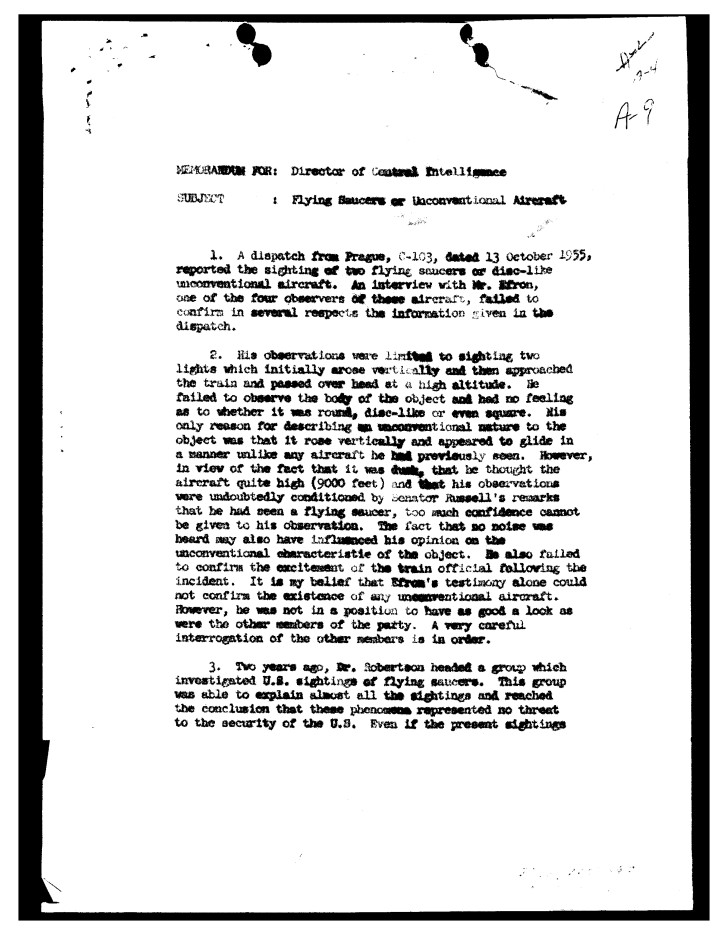
CIA-UAP-D021, Analysis of Unconventional Aircraft Sightings, 1955
Sections 1 and 2 of this memorandum document a 1955 analysis of reports of “flying saucers” or “unconventional aircraft,” referencing the incident described in observer debriefings contained within CIA-UAP-D020. The memo summarizes the incident as consisting of two lights rising vertically, then passing above the observers. The memo contains caveating language that suggests the author concluded that the reports, as described, did not indicate the presence of an “unconventional aircraft.” Section 3 cites a previous finding by Dr. [Howard] Robertson (of the 1953 Robertson Panel) that “almost all the sightings […] represented no threat to the U.S.” Section 4 discusses the state of then-current research into “saucer-like aircraft” under Project “Y,” a contemporary joint U.S.-Canadian aerospace development program.
Editor's note: A companion CIA analysis file from 1955 that helps show how sightings moved from report to assessment inside the intelligence record.
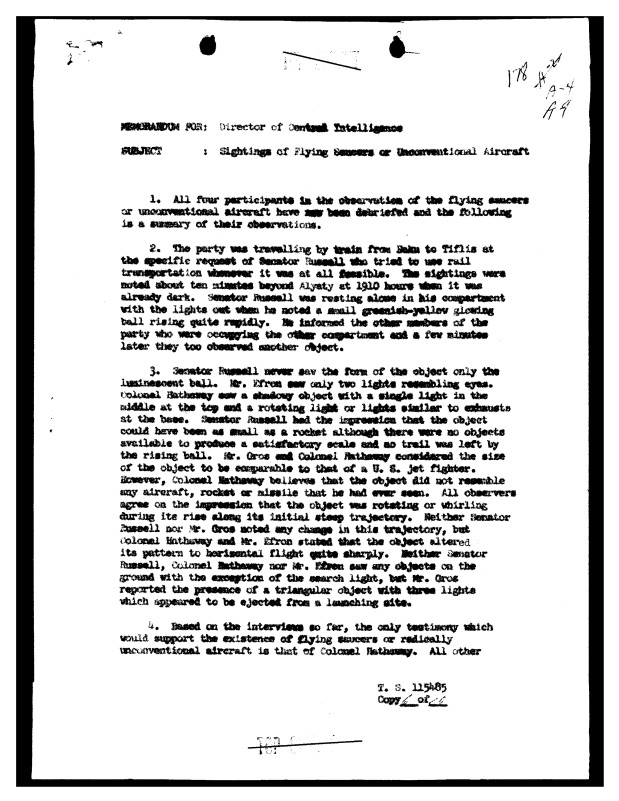
CIA-UAP-D020, Memorandum on Unconventional Aircraft Sightings, 1955
This memorandum summarizes a Central Intelligence Agency (CIA) debriefing of a group of four individuals who reported observing a “flying saucer” or “unconventional aircraft” in 1955. The group, which included U.S. Senator Richard Russell, a U.S. military service member, and two U.S. Government officials, reported observing a luminescent “greenish-yellow” phenomenon, as seen from aboard a train while traveling within the Soviet Union, in present-day Azerbaijan, between Baku and Tiflis (Tbilisi, Georgia). The document concludes by stating that the observation can “probably be explained as steep climbing aircraft or missiles,” and that “the evidence does not appear sufficiently firm to warrant the conclusion that the Soviets have developed […] a radically new type of aircraft.” The document “CIA-UAP-D021” contains a contemporary analysis of the incident.
Editor's note: A 1955 CIA memo on unconventional aircraft sightings — useful for understanding how intelligence channels treated unexplained aerial reports during the Cold War.
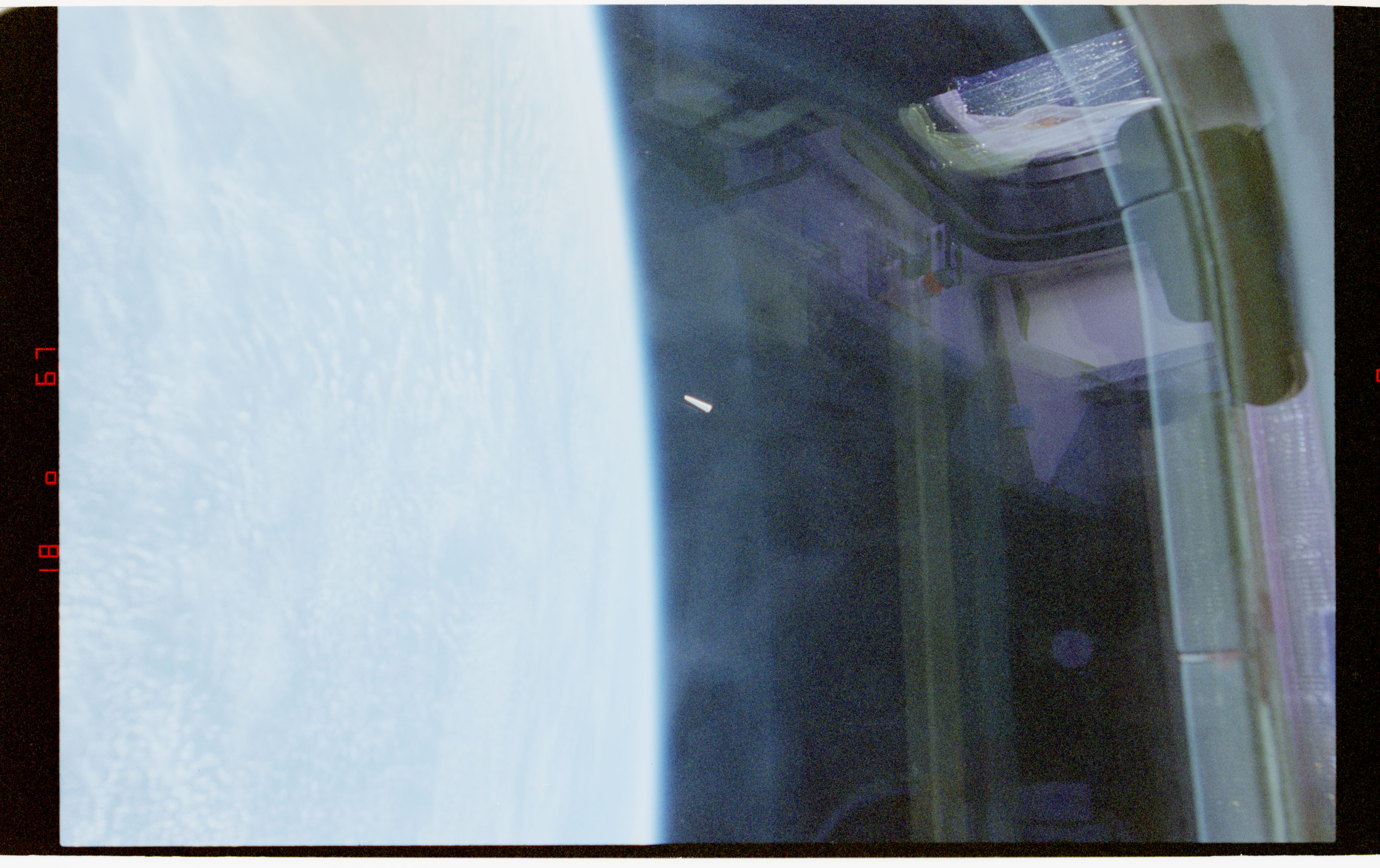
NASA-UAP-D030, STS-80 Unidentified Object Image 1, 1996
During STS-80, between November 19 and December 7, 1996, astronauts aboard Space Shuttle Columbia captured a series of three images of an unidentified object in low-Earth orbit. In the first photograph, the object is visible near the center of the frame, to the right of the limb of the Earth.
Editor's note: A NASA image from Space Shuttle Columbia's STS-80 mission showing an unidentified object in low-Earth orbit. Visually compelling, but best treated as a source image for review rather than a determination. War.gov's Release 04 page references the STS-80 image set in the carousel/record text.
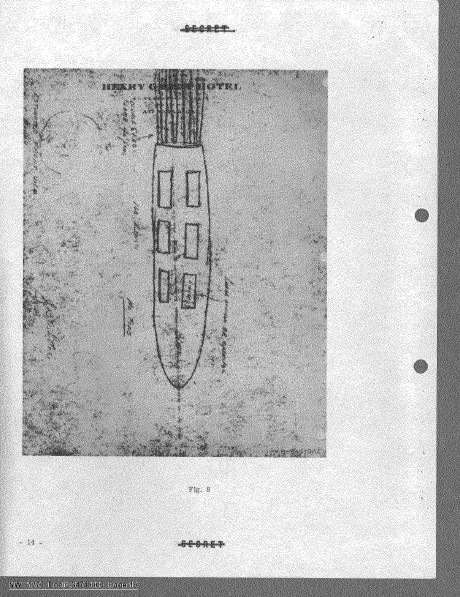
DOW-UAP-D094, Analysis of Flying Object Incidents in the United States, 1949
This file contains a U.S. Air Force (USAF) Air Intelligence Division study, “Analysis of Flying Object Incidents in the United States,” Study No. 203, dated 04/28/1949. The analysis includes an assessment of various reported unidentified flying object (UFO) incidents and theories to account for their nature and origin. Overall, the study assesses that “it appears that some object has been seen; however, the identification of that object cannot be readily accomplished.” The study offers that two “reasonable” origins might account for the phenomena: technologies of a domestic or foreign origin. It also suggests that, if foreign, it is prudent for the United States to assume that UFO observations are attributable to scientific, military, or intelligence activities of the Soviet Union, and, in that case, to take seriously the threat such objects may pose. The file also contains selected contemporary UFO reports and examples of experimental “flying wing” type aircraft planforms that might account for certain commonly reported UFO characteristics. AARO Comment: This file appears to be a later revision of the file contained in DOW-UAP-D093, whose content is substantively similar.
Editor's note: Early Air Force analysis of flying-object reports from 1949 — a valuable historical baseline for how the government first tried to categorize unexplained aerial incidents.
All Files
Browse every official file in this Drop.
Unlock the full Drop archive — every PDF, image, video, and audio file — with a Supporter membership.
View plansFile Breakdown
Unlock the full Drop archive with a Supporter membership.
Supporter